The US has lost its war against Iran, undertaken at the behest of Israel, and now Iran is pressing home its advantage by having its proxy force, the Houthis of Yemen, seize all of the west of the country so that they have control not just of the Strait of Hormuz but also of the Bab el-Mandeb Strait at the south of the Red Sea and for good measure they have attacked and shut the pipeline running across Saudi Arabia to the Red Sea through which a lot of oil production had been diverted as a result of Hormuz being blocked – if they repair it, it will easy to put it out of action again. So basically they have gained control of about 30% of the world’s oil production and a lot of the world’s shipping which, to put it mildly, puts them in a strong bargaining position. In addition to all this, most US bases across the region have been badly damaged or destroyed by Iranian missiles and it looks like Iran is not going to settle for anything less than running the US out of the region.
While Trump would no doubt be happy to blow up half of the world to please Israel, he apparently wants to do as well as possible in the mid-term elections (even though the same plutocrats control both parties) which are in November and now fast approaching but if he is to have any hope of doing well, he has to head off any further rise in the oil price and ideally get the price moving down again. The only way he can achieve this is to cut a deal with Iran and that will mean major concessions, given that Iran is already the victor in the conflict. The blow will be softened by the fact that he can rely on the mainstream media to present this defeat to the dumb American public as some sort of victory, since many of them still believe what they see on the televisión (the good news is that they are at last starting to wake up) and of course as soon as the elections are over, he, or whoever is in power, can renege on any deal made as usual and go back on the offensive, although this won’t alter the fact that munitions, especially defensive missiles, are severely depleted, so Iran is likely to maintain the upper hand. The point is that he has an incentive to cut a deal in coming weeks, even if it’s a bad one, to bring down or at least contain the price of oil to improve his chances in the mid-terms. Another big reason to do a deal is so that Saudi Arabia and other Gulf States can restore their oil revenues and then recycle them into garbage US Treasuries which is urgent as the US Treasury market is on the rocks, especially now that the Yen carry trade is collapsing.
A key point to note is that Iran may be in no mood to cut a deal with the US – it may decide to “finish the job” of taking down the US Treasury market and thus the US economy by refusing to enter into any kind of deal at all and thus bring to an end at last the lurking threat from Israel and US that has persisted for decades, although we cannot rule out that as a last resort the latter use nukes in an effort to get their way.
Aside from all this we have an important Fed meeting on Tuesday and Wednesday when an already “baked in” modest quarter point rate hike is likely to occur. The charts that we are looking at below all show that we are at a key inflection point and which way they break probably depends more on the Fed’s future guidance rather than the expected hike, although if they were to raise rates by half a percentage point that would likely trigger a breakdown.
Otherwise, if a sudden deal “breakthrough” with Iran is announced in the near future, it could trigger a relief rally, but it has to be said that overall the charts look bearish and in fact they look like “A Perfect Storm” is brewing.
Here are the major bearish factors in play…
- The effect of the war on Iran has been to destroy the perception of the US as the dominant world hegemon, capable of imposing its will anywhere in the world. Iran has exposed US military strategy and weaponry as being 30-years out of date and in the case of its weaponry as being vastly, almost prohibitively overpriced. This dramatic loss of power and status will ultimately lead to the collapse of the US Treasury market and thence the dollar.
- The already crippling US debt will become increasingly unservicable as the collapse of the Treasury market and the dollar leads to a parabolic blowoff in interest rates.
- The US Commercial property market is already in freefall and this will accelerate leading to contagion into the residential market and other sectors. China has already amply demonstrated what can happen to the property market although there the problem was made even worse by communist central planning and the market distortions arising from this bureacratic meddling.
- The grotesquely inflated AI and Tech sector bubbles will implode. Olders readers will recall what happened to the Tech bubble at the start of this century – it doesn’t matter how great the technology is or what benefits it promises to deliver – if too much speculative hot money flows in, it always leads to a nasty retrenchment. When these sectors implode they will take down the rest of the market and the Fed will be “pushing on a piece of string” if they continue to try to keep these sectors up by creating more and more money out of thin air.
If rates do continue to rise and the stock market finally buckles and caves in, most everything will be taken down, even including gold and silver for a while, although they will quickly bounce back before the market hits bottom, as in 2008. In a meltdown situation the dollar may spike briefly but it’s recovery will be short-lived.
So, in order to avert an imminent market meltdown and rates spike, not to mention a continued rise in the oil price, the US will have to eat humble pie and cut a deal favorable to Iran fast. The charts that we will now look at show clearly that we are at a critical juncture.
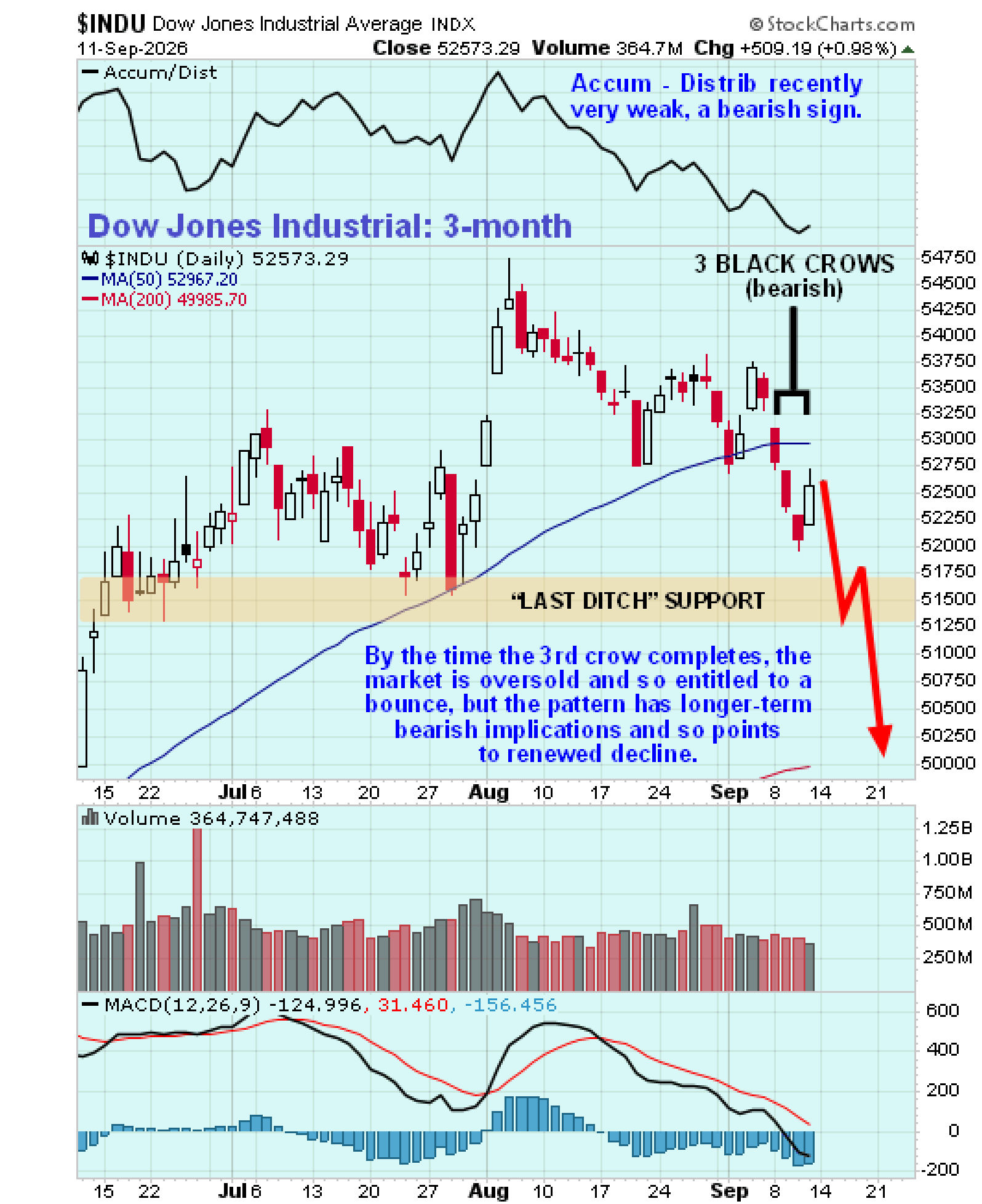
Starting with the 3-month chart for the Dow Jones Industrials the 3 Black Crows pattern (and we can even say that it’s 4) that appeared last week has bearish implications, although by the time the 3rd crow appeared the market had already become short-term oversold, hence Friday’s bounce. The gap between each of these candlesticks gives it an even more bearish tone, so there is a good chance it will drop next week, but much depends on the Fed’s stance.
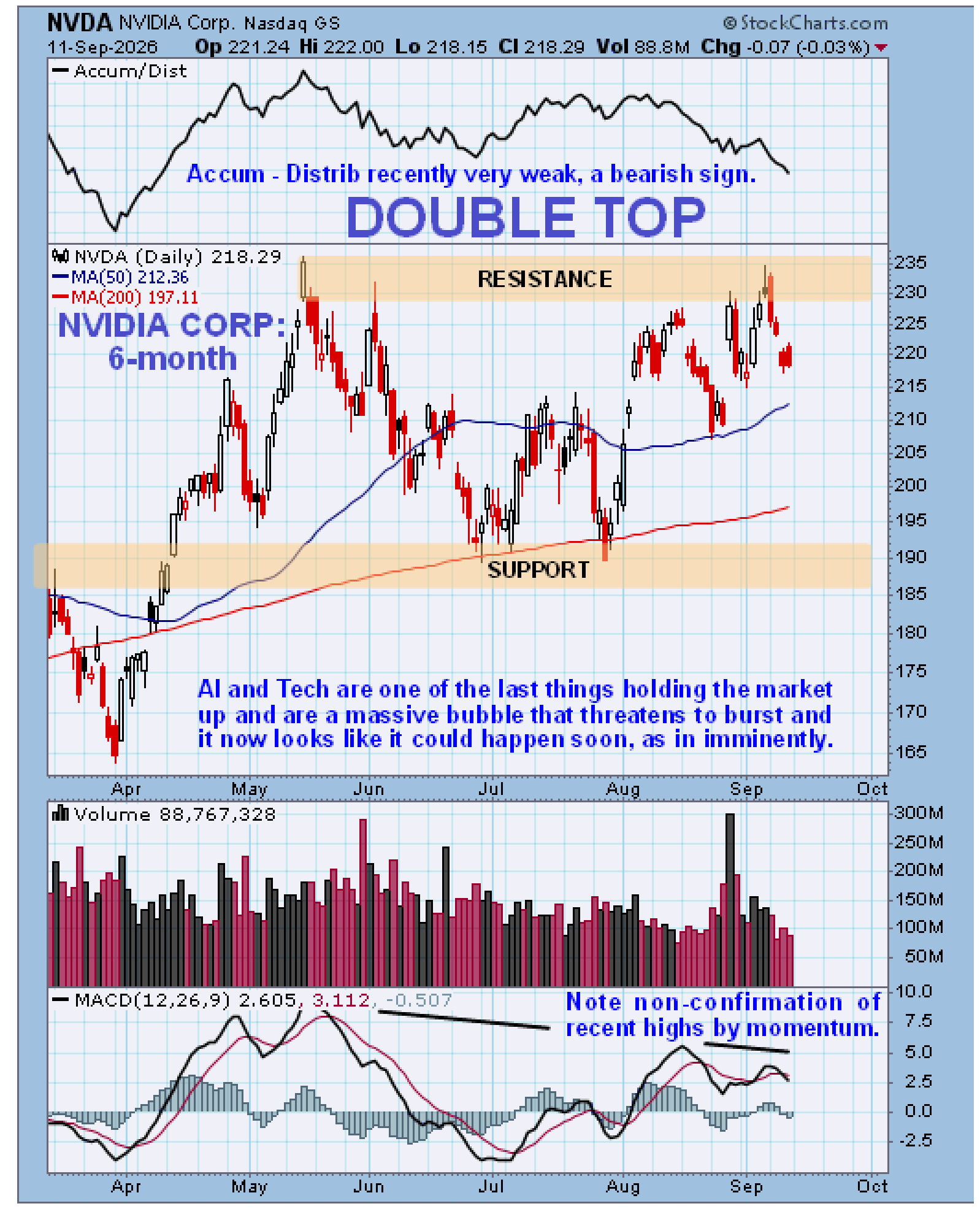
With respect to the overblown Tech sector, the Nvidia chart continues to look bearish with a potential Double Top having formed. There has been quite heavy downside volume over the past month with the Accumulation line weak as a result. This has bearish implications for the Tech sector…
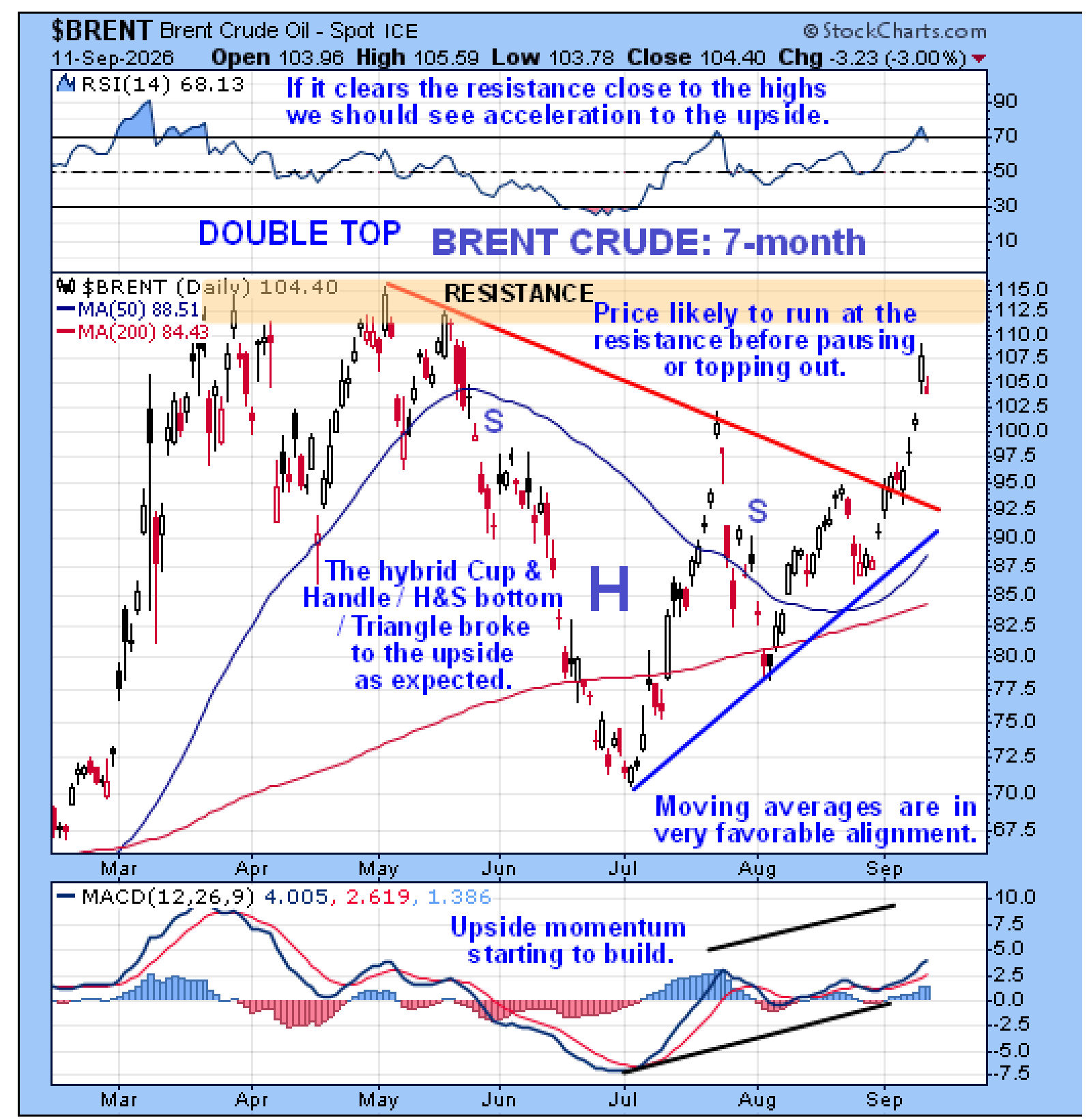
Oil did as we expected towards the end of August and broke out upside from its triangular pattern and has advanced towards an initial target at its March – May highs. Whether it gets beyond them depends on developments in the Mid-East, in particular whether Trump sues for peace in order to bolster his chances in the mid-terms.
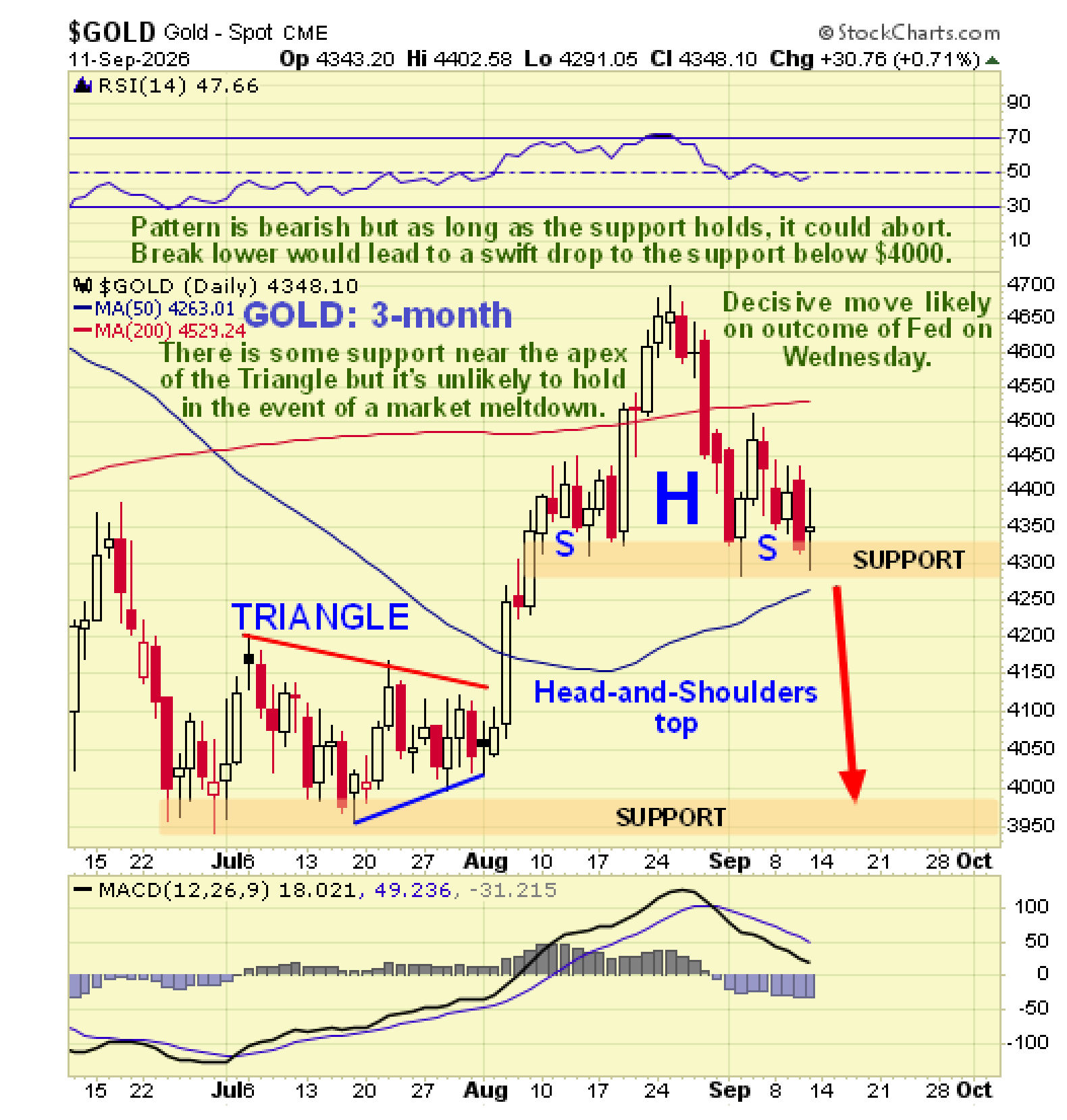
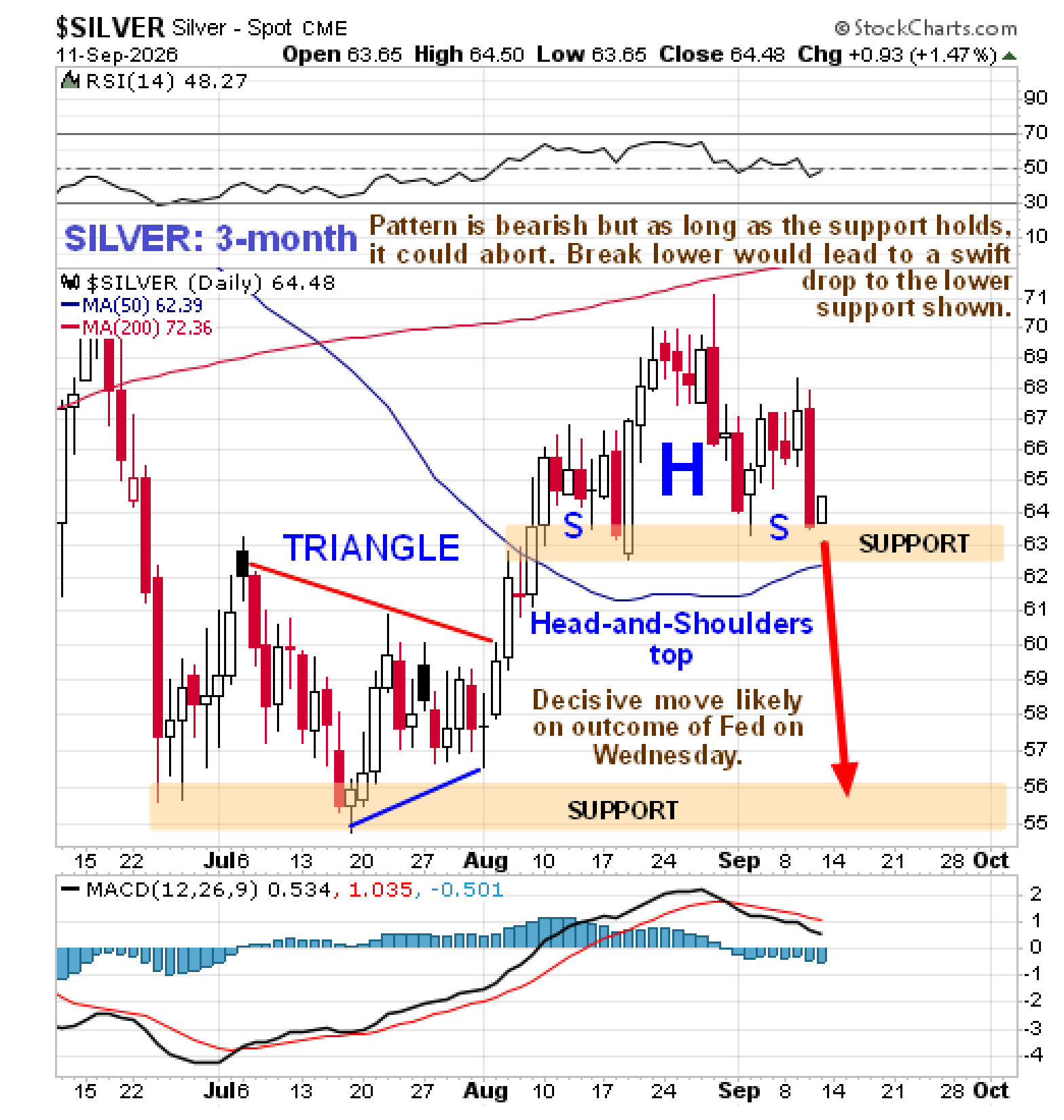
A clear Head-and-Shoulders top has formed in gold over the past month or so that looks quite ominous. While the pattern could abort, depending on what happens this coming week, failure of the support at its lower boundary can be expected to lead to a quite steep drop down to the next support level.
The situation is very similar with silver..
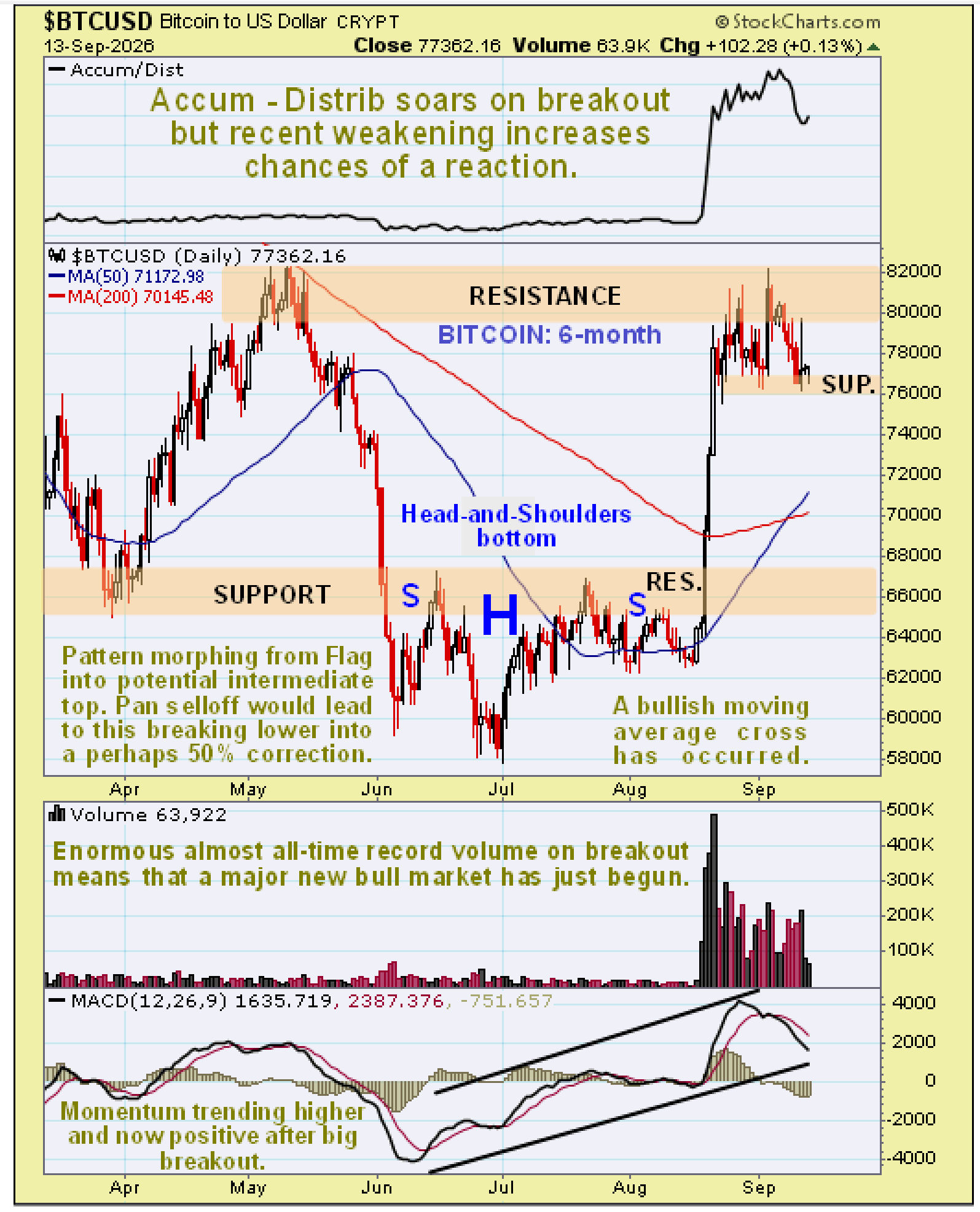
Lastly, you may recall that we had thought that a bull Flag was forming in Bitcoin but now it looks like the pattern may be morphing into an intermediate top that leads to say a 50% correction of the recent steep upleg. If it does breach the support at the lower boundary of the potential Flag, then we can expect gold and silver to break lower at the same time. Like gold and silver, the direction it breaks will likely be determined by the developments in the Mid-East and the outcome of the Fed meeting.
End of update.
Posted at 3.10 pm on 13th September 26.